
Beyond the Spectacle: What Scientists Study During a Total Solar Eclipse
While millions of people travel to the path of totality simply to marvel at the beauty of a solar eclipse, scientists are busy at work. A total solar eclipse provides a rare, natural laboratory that allows researchers to study phenomena that are otherwise invisible or impossible to recreate. Even with modern satellites and space telescopes, the few minutes of totality remain crucial for cutting-edge science.
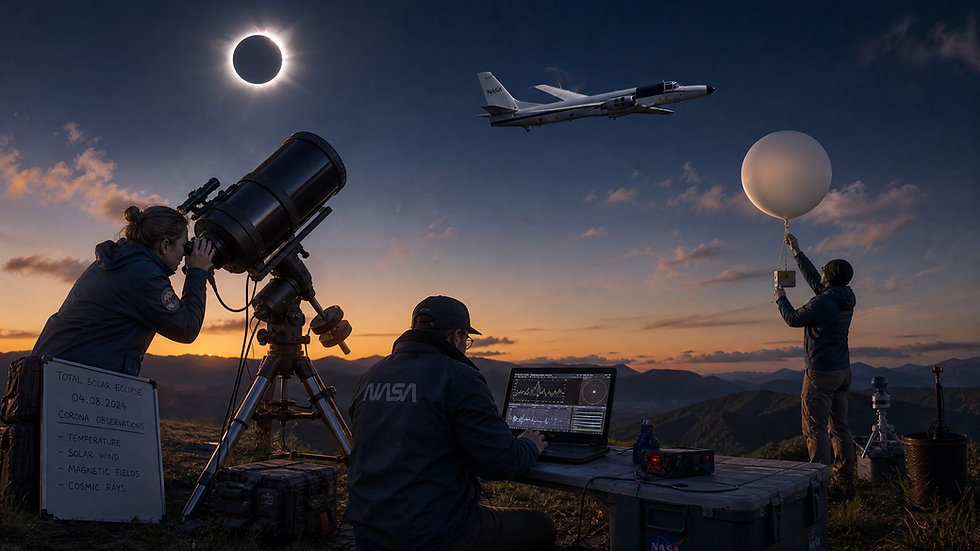
Unlocking the Secrets of the Corona
The primary focus of eclipse science is the Sun's corona—its outer atmosphere. The corona is a mystery; it is millions of degrees hotter than the surface of the Sun itself, and scientists still don't fully understand why .
Normally, the Sun's surface is so bright that it completely washes out the faint light of the corona. While scientists use instruments called coronagraphs to block the Sun's disk, these instruments also block the innermost part of the corona. During a total eclipse, the Moon acts as a perfect, natural coronagraph, revealing the lower corona in unprecedented detail . Researchers use this brief window to study how heat and energy are transferred from the Sun's surface into the corona, and how the solar wind—the stream of charged particles that affects Earth—is generated .
Monitoring the Ionosphere
An eclipse doesn't just affect the Sun; it has a profound impact on Earth's atmosphere. The ionosphere is a layer of the upper atmosphere filled with charged particles (ions) created by solar radiation. This layer is crucial because it reflects and modifies radio waves used for communication and navigation .
During an eclipse, the sudden drop in solar radiation causes the ionosphere to rapidly change. It's like a sudden, localized nightfall. Scientists use radar networks, such as SuperDARN, and launch sounding rockets directly into the Moon's shadow to measure how the ionosphere reacts to this rapid cooling and loss of radiation . Understanding these changes helps improve the reliability of GPS and radio communications.
Catching Coronal Mass Ejections
Sometimes, the Sun violently ejects massive clouds of plasma and magnetic fields, known as Coronal Mass Ejections (CMEs). If a CME hits Earth, it can trigger geomagnetic storms that disrupt power grids and satellites. Eclipses provide a unique opportunity to observe CMEs as they accelerate through the lower corona, helping scientists improve space weather forecasting .
The Rise of Citizen Science
You don't need a PhD to contribute to eclipse science. NASA and other organizations heavily rely on citizen scientists during eclipses. Projects like the Eclipse Soundscapes Project ask volunteers to record audio of their surroundings to study how animals react to the sudden darkness . Other projects involve amateur astronomers photographing the corona to help map its structure, or students launching high-altitude weather balloons to measure atmospheric changes .
A total solar eclipse is a breathtaking reminder of our place in the solar system, but for scientists, it's a few precious minutes of intense, invaluable discovery.


Comments