
What an Eclipse Cruise! Why We Chose the Sea for Spain’s 2026 Solar Eclipse
On 12 August 2026, our eclipse plans finally left the shore. Just Stargaze, powered by Astronomy Tours S. COOP., welcomed guests aboard eclipse cruises departing from Cartagena and Torrevieja on the Mediterranean, and Santiago de la Ribera on the Mar Menor.
There was music, a cooling sea breeze, drinks, conversation and the unmistakable excitement of waiting for the Moon to move across the Sun. But this was not simply a pleasant cruise with an eclipse added to the itinerary. The decision to observe from the water was the result of years of astronomical and practical planning.
We chose the sea because the eclipsed Sun would be extremely low above the western horizon. We also knew that clouds could change the outcome in minutes. On the water, our captains could adjust position and search for the best available line of sight.
That flexibility mattered. Clouds arrived, the boats moved, and our guests saw the spectacle we had worked so long to make possible.
The plan began with the horizon
The geometry of the 2026 eclipse created an unusual challenge in Spain. The path of totality crossed the north of the country near sunset, while the Costa Blanca and Costa Cálida experienced a very deep partial eclipse. From our region, the Moon covered approximately 98–99% of the solar disc at maximum.
The percentage was spectacular. The position was difficult.
The Sun was only a few degrees above the west to north-western horizon. At that height, an ordinary apartment block, hill, tree line, mountain ridge or piece of port infrastructure could hide it completely. Spain’s Instituto Geográfico Nacional had warned that the eclipse would occur close to sunset and that observers needed a clear view towards the west.[1]
This was especially important on the east coast. Many beautiful beaches face the Mediterranean to the east. The open water may look perfect, but the eclipse itself was happening in the opposite direction—over the land and its obstacles.
A clear horizon was not a luxury. It was the foundation of the entire observation plan.
Why the water was a strategy, not just a setting
A boat does not guarantee clear weather, and it does not make clouds disappear. What it provides is mobility and control over the viewing geometry.
From Cartagena and Torrevieja, our vessels could move away from fixed coastal obstacles and position guests for the western horizon. From Santiago de la Ribera, the broad surface of the Mar Menor offered the same essential advantage: an open line of sight and room to adjust.

The water also gave the captains options when clouds began to interfere. A person on land may have a perfect plan but remain trapped by parking, crowds, blocked roads or a horizon that cannot be changed. At sea, our teams could communicate, evaluate the breaks in the cloud and relocate the boats.
That is exactly what happened.
Clouds added tension to the final part of the afternoon. Instead of waiting helplessly beneath one patch of sky, the captains worked together to improve our position. The result was the view we had hoped for: the deeply eclipsed Sun appearing through the changing cloud, low above the water.
Why we did not take our guests into the path of totality
As astronomers, we know that totality is unique. When the Moon covers the Sun completely, the solar corona becomes visible and the experience is qualitatively different from even a 99% partial eclipse. The scientific and emotional pull of the path of totality was very strong for us.
Nevertheless, we chose to stay in south-eastern Spain and create a carefully managed local experience for our guests.
Reaching totality would have required a major relocation during the busiest part of August. It would have meant long journeys in intense heat, pressure on roads and parking, rapidly changing restrictions, wildfire precautions and large crowds converging on a narrow band across the country. Spanish authorities prepared for hundreds of thousands of additional journeys, and significant congestion was reported on several routes after the eclipse.[3] [4]
Most importantly, travelling into the totality zone did not guarantee a view. Cloud and low fog spoiled the eclipse at a number of fixed observation sites, including parts of the Asturian coast, while other locations saw the Sun only when a gap opened at the crucial moment.[3] [4]
We could not promise our clients totality. We could promise a realistic, professionally planned experience built around the conditions on the ground—or, in this case, on the water.
We are extremely happy with that decision.
Three departures, one shared sky
Each departure had its own landscape and atmosphere.
From Cartagena, guests watched the Sun descend towards a rugged coastal horizon. The vessel gave us the room to work around the surrounding relief and the port environment rather than accept a fixed view from land.
From Torrevieja, the cruise opened the horizon beyond the urban coastline. Guests could sit comfortably, put on their certified eclipse glasses and follow the Moon’s progress together.
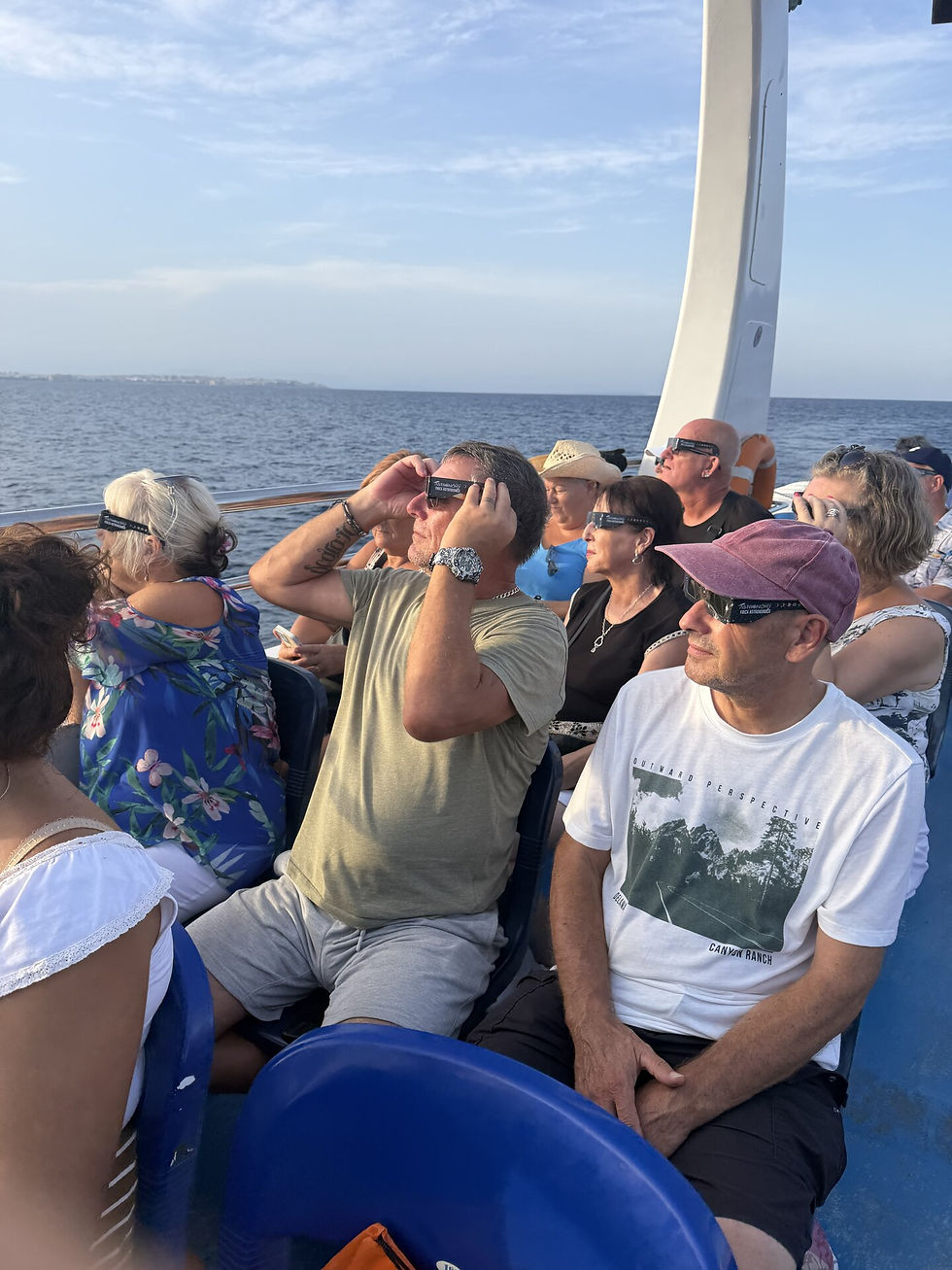
From Santiago de la Ribera, the Mar Menor became a natural observing platform. Its open water made the low Sun visible and allowed the boat to adjust as clouds shifted across the western sky.
The three cruises were connected by the same idea: choose the horizon deliberately, remain mobile and make the experience safe, comfortable and memorable.
More than a view through eclipse glasses
Every guest received certified solar eclipse glasses and an astronomy goodie bag. Activities on board helped people understand what they were seeing, while our astronomers answered questions, explained the changing phases and helped guests observe and photograph the event safely.

Then the atmosphere changed.
As the Moon covered more of the Sun, the light became muted and unfamiliar. The sea breeze felt colder. Near maximum eclipse, darkness gathered around the boats and the temperature dropped noticeably. Conversations paused, cameras rose and people tried to absorb a scene that no photograph can reproduce completely.
It was not night, and it was not an ordinary sunset. With only a thin part of the solar disc still visible, the coast and water took on an uncanny twilight character. The experience reached far beyond the image of the Sun itself: it was felt in the light, the air, the colour of the sea and the shared reaction of everyone on board.
Years of planning, one unforgettable evening
Eclipses are predictable to the second, but successful observing is never guaranteed. The landscape, the weather and the movement of people all matter.
After years of preparation, we achieved what we set out to do. Our guests avoided a difficult long-distance relocation and experienced 98–99% solar obscuration from comfortable boats with trained astronomical guidance, safe equipment and the freedom to respond to changing cloud.
The result was not simply a photograph of a crescent Sun. It was an adventure shared by guests, astronomers and captains across three ports—an evening of science, anticipation, quick decisions and genuine wonder.
The next horizon: the 2027 total solar eclipse
Spain’s next total solar eclipse arrives on 2 August 2027, crossing southern Spain as part of a path that continues across North Africa and the Middle East.[1] [2]
We are already preparing.
The lessons of 2026 will guide every decision: study the geometry, respect the weather, build flexibility into the plan, put safety first and never treat the horizon as an afterthought.
If you would like to follow our 2027 plans, visit Just Stargaze at https://www.juststargaze.com/ and subscribe for updates. The next eclipse story has already begun.
Sources
[1] Instituto Geográfico Nacional, “Total solar eclipse, August 12, 2026”: https://astronomia.ign.es/en/eclipses-de-sol-y-luna/eclipse-total-sol-de-12-de-agosto-2026
[2] European Space Agency, “Total solar eclipse 12 August 2026 – Map of totality in Spain”: https://www.esa.int/ESA_Multimedia/Images/2026/05/Total_solar_eclipse_12_August_2026_Map_of_totality_in_Spain
[3] The New York Times, “First Total Eclipse in Europe in Decades Turns Day to Night”: https://www.nytimes.com/live/2026/08/12/world/solar-eclipse-2026-updates
[4] El Mundo, live coverage of the 12 August 2026 eclipse in Spain: https://www.elmundo.es/ciencia/2026/08/12/6a7bfec73e9f6f8c525c1482-directo.html
Comments