
The Cosmic Coincidence: The Science Behind Solar Eclipses
When the sky goes dark in the middle of the day, it's hard not to feel a sense of awe. But what exactly is happening up there? The science behind a total solar eclipse is a fascinating tale of celestial mechanics, geometry, and one massive cosmic coincidence.
The Perfect Fit
The most mind-boggling fact about a total solar eclipse is that it happens at all. The Sun is about 400 times larger in diameter than the Moon. However, the Sun also happens to be about 400 times farther away from Earth than the Moon . This incredible coincidence means that, from our perspective on Earth, the two bodies appear to be almost exactly the same size in the sky. When they align perfectly—a phenomenon known as syzygy—the Moon can completely cover the Sun's face .
The Mechanics of the Shadow
A solar eclipse only occurs during a new moon, when the Moon passes between Earth and the Sun. So why don't we have an eclipse every month? The Moon's orbit is tilted by about five degrees relative to Earth's orbit around the Sun . Most months, the Moon's shadow passes above or below Earth. It's only during "eclipse seasons"—twice a year—that the alignment is just right .
When the alignment is perfect, the Moon casts a shadow with two parts:
•The Umbra: The dark, inner shadow. If you are standing in the path of the umbra, you will experience a total solar eclipse .
•The Penumbra: The lighter, outer shadow. If you are in the penumbra, you will only see a partial eclipse .
The Saros Cycle
Eclipses aren't random; they follow a predictable pattern known as the Saros cycle. A Saros cycle lasts 18 years, 11 days, and 8 hours . After this period, the Sun, Earth, and Moon return to almost the exact same relative geometry. This means that eclipses separated by one Saros cycle will have similar characteristics, though they will be visible from different parts of the Earth due to the extra 8 hours allowing the Earth to rotate an additional third of a turn .
Baily's Beads and the Diamond Ring
As the Moon moves to cover the Sun, the rugged, cratered lunar landscape plays a role. Just before totality, sunlight peeks through the valleys and craters on the Moon's edge, creating a string of bright spots known as Baily's Beads .
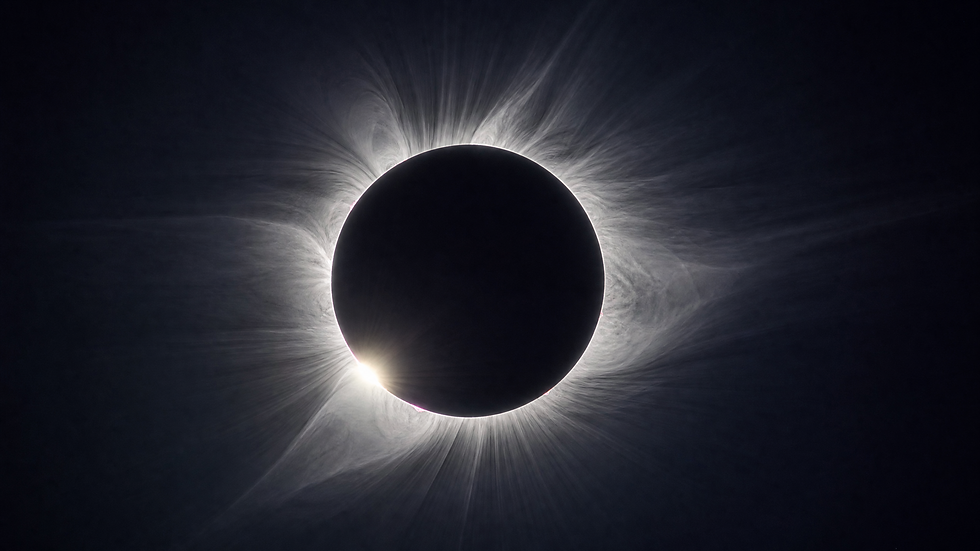
As these beads vanish, a single, brilliant point of light remains, resembling a sparkling diamond set on a glowing ring. This is the famous Diamond Ring effect, and it signals that totality is just seconds away.
The Sun's Hidden Crown
Perhaps the greatest scientific gift of a total solar eclipse is the view of the corona, the Sun's outer atmosphere. The corona is a chaotic, superheated region of plasma that extends millions of miles into space . Normally, the overwhelming brightness of the Sun's surface (the photosphere) hides the corona. But during totality, the corona reveals itself as a ghostly, pearly-white halo of wisps and streamers .
Understanding the mechanics of an eclipse transforms a magical experience into a profound appreciation for the intricate dance of our solar system.


Comments