
The Quest for Totality: Spain's 2026 Sunset Eclipse and the Reality of the Road
Updated: Jul 21

At 20:29 on the evening of Wednesday, August 12, 2026, the moon's shadow will fall on the city of Burgos. For one minute and forty-four seconds, the sky above that ancient Castilian city will turn the colour of deep twilight. The solar corona — the sun's outer atmosphere, invisible in ordinary daylight — will blaze into view like a white crown above the horizon. Stars will appear. The temperature will drop several degrees in seconds. And then, as suddenly as it began, it will be over.
This will be the first total solar eclipse visible from the Iberian Peninsula since 1912 . More than a century has passed since the moon's shadow last swept across this landscape. And on August 12, 2026, it will do so again — but with a twist that makes this one of the most logistically demanding eclipse experiences in European history. Spain sits at the very end of the eclipse's global path, meaning totality will occur just as the sun is setting. The eclipse will happen low in the sky, close to the horizon, over a country baking in August heat, packed with summer tourists, and crossed by millions of people driving to find their perfect patch of darkness.
This is not a simple "look up and enjoy" event. This is a quest.
The Eclipse That Took 114 Years to Return
To understand why this eclipse matters so deeply, consider the numbers. A total solar eclipse visits any given location on Earth approximately once every 360 years on average . The last time the Iberian Peninsula experienced totality was on April 17, 1912 — a date before the First World War, before commercial aviation, before television. Everyone alive in Spain today has lived their entire life without ever seeing a total solar eclipse from their own country.
The 2026 eclipse is also the first of what astronomers are calling the Iberian Eclipse Trilogy: three major solar eclipses crossing Spain in rapid succession. The second, another total eclipse, will cross southern Spain on August 2, 2027. The third, an annular eclipse, will follow on January 26, 2028. After that, Spain will not see another total solar eclipse until 2053 . The window of opportunity is extraordinary, and August 12, 2026 is the opening act.
The eclipse's global path begins at sunrise over the uninhabited Taymyr Peninsula of Siberian Russia, arcs north over the Arctic Ocean and eastern Greenland, sweeps across the western edge of Iceland, and then descends through the North Atlantic to strike Spain's northwestern coast . The maximum duration of totality for the entire eclipse — 2 minutes and 18 seconds — occurs near Iceland. By the time the shadow reaches Spain, it has been travelling for hours, and the sun is sinking toward the horizon.
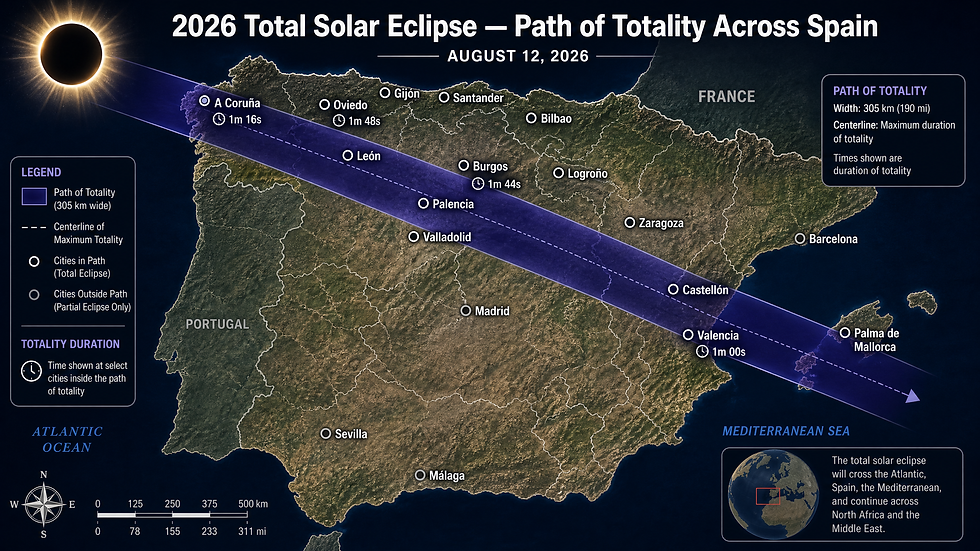
The path of totality enters Spain from the Atlantic Ocean, striking the Galician coast first, and then sweeps east-southeast across the northern half of the country before exiting over the Balearic Islands. The path is approximately 305 kilometres (190 miles) wide .
The critical thing to understand is that Madrid and Barcelona — Spain's two largest cities — lie outside the path of totality. Residents of those cities will see a very deep partial eclipse, with the moon covering 97% or more of the sun's disk. But a 97% partial eclipse is not totality. The remaining 3% of direct sunlight is still overwhelmingly bright; the corona will not appear, the stars will not emerge, and the sky will not go dark. For eclipse chasers, there is a simple rule: totality or nothing .
The following table summarises the key data for major cities inside the path, sourced from the Instituto Geográfico Nacional (IGN) :

Note: Bilbao sits near the northern edge of the path; exact duration depends on precise location within the city. Always verify your specific coordinates using the IGN interactive tool or Xavier Jubier's eclipse map .
The longest totality in Spain — approximately 1 minute and 49 seconds — occurs near León and Oviedo, close to where the centreline of the eclipse first crosses the Spanish coast. As the shadow moves east and south, the sun drops lower, and the duration of totality decreases slightly. By the time the shadow reaches Palma de Mallorca, the sun will be only 2 degrees above the horizon — the height of your thumb held at arm's length .
The Sunset Problem: Why This Eclipse Is Unlike Any Other
Every eclipse is unique, but the 2026 Spanish eclipse presents a challenge that experienced eclipse chasers consider one of the most demanding in recent memory: the sun is setting during totality.
In northwestern Spain — Galicia and Asturias — the sun will sit roughly 10 to 12 degrees above the horizon when the moon's shadow arrives. That sounds low, but it is manageable. A clear hilltop or open field will do the job. However, as the shadow sweeps east and south, the sun drops progressively lower. By Valencia, it is 4 degrees above the horizon. By Palma de Mallorca, it is 2 degrees — barely a finger's width above the horizon line .
This geometry creates a profound observational challenge. Looking at an object just 2 degrees above the horizon means peering through an enormous column of Earth's atmosphere — hundreds of miles of air, haze, dust, and potential cloud cover. Even if the sky directly overhead is perfectly clear, a bank of distant clouds along the horizon, well beyond the range of any local weather forecast, can completely block the view . This is why eclipse experts at Besselian Elements note that standard weather forecasts are largely irrelevant for the Balearic Islands portion of the eclipse; what matters is the transparency of the atmosphere along the entire line of sight to the horizon.
There is also a cruel irony for Spain's Mediterranean coast. The famous beach resorts of Valencia, Alicante, and the Costa Blanca are designed to face east — toward the sunrise, toward the sea. The eclipse will happen low in the west-northwest, behind the hotels, the promenades, the hills, and the urban skyline . Millions of tourists will be in exactly the wrong place, looking in exactly the wrong direction.
Spain's Terrain: Your Greatest Enemy and Best Friend
Spain is one of the most topographically varied countries in Europe. Its average elevation is the second highest in Europe after Switzerland, and its interior is dominated by a vast elevated plateau — the Meseta Central — ringed by mountain ranges. This landscape is spectacular to visit, but for a low-altitude sunset eclipse, it can be catastrophic for viewing.
Galicia: Beautiful but Risky
Galicia's Atlantic coast is green, hilly, and deeply indented with rías — drowned river valleys that create a dramatic but complex horizon. The region's famously changeable weather, driven by Atlantic fronts, means cloud cover is a genuine risk even in August. While the sun will be 12 degrees above the horizon here — the highest in Spain during totality — the hilly terrain means that many seemingly open locations will have a ridge or forested hillside blocking the critical western view. Galicia rewards careful scouting. The best sites are elevated coastal headlands or open hilltops with a clear Atlantic panorama to the west.
Asturias and Cantabria: The Picos de Europa Dilemma
The Cantabrian Mountains, including the spectacular Picos de Europa, run parallel to the northern coast just inland. They are among the most dramatic mountains in Spain, but they create a wall that can block the setting sun at precisely the wrong moment. Observers in the valleys of Asturias and Cantabria need to position themselves on the seaward side of these ranges, with an unobstructed view to the west. The coastal strip between the mountains and the sea is narrow and will be extremely crowded. Oviedo and Gijón, sitting on the coastal plain, offer the best urban options, with nearly 1 minute and 48 seconds of totality and a relatively clear western horizon over the Bay of Biscay.
Castilla y León: The Eclipse Chaser's Paradise
The vast inland plateau of Castilla y León is the consensus best location for the 2026 eclipse, and for good reason. The Meseta is flat, open, and agricultural — endless wheat fields and cereal crops stretch to the horizon in every direction. There are no mountains to block the low sun. The August skies here are reliably clear, with some of the lowest cloud-cover statistics in northern Spain. And the region sits close to the eclipse centreline, offering maximum totality duration.
The provinces of Palencia, Burgos, León, and Soria are particularly well-positioned. The New York Times, in a June 2026 feature, described Soria as a place "where it seems the stones dream" — a landscape of open cropland, scattered oak groves, and medieval villages that offers both excellent eclipse viewing and extraordinary cultural depth . The astrophysicist Eva Villaver, deputy director of the Institute of Astrophysics of the Canary Islands and a native of Palencia, told the NYT that the open areas around Frómista are "perfect viewing points" for the eclipse, and that the region has been "chosen by nature" .
The Spanish central government has told Castilla y León to expect up to two million visitors for the eclipse . The region's depopulated villages and sparse infrastructure will be tested to their absolute limits.
Aragón and the Ebro Valley: Hot but Clear
The Ebro Valley in Aragón is one of Spain's driest and sunniest regions, and its flat terrain offers excellent western horizons. However, it is also one of the hottest parts of Spain in August, with temperatures regularly exceeding 38°C (100°F). The city of Zaragoza will experience approximately 1 minute and 20 seconds of totality with the sun at 6 degrees above the horizon. The flat agricultural land surrounding the city is ideal for viewing, but the heat and the distance from the centreline make it a secondary option compared to Castilla y León.
Valencia and the Mediterranean Coast: The Wrong Side of Spain
As noted above, the Mediterranean coast faces east. This is not a minor inconvenience — it is a fundamental obstacle. The sun during totality will be in the west-northwest, and in many coastal locations it will be behind buildings, hills, or the urban skyline. Space.com's eclipse planning guide explicitly warns that "its resorts are designed to face east toward the sea for sunrise views, while the eclipse occurs low in the west-northwest, close to sunset" . Eclipse chasers who have booked beach holidays in Valencia or Alicante will need to drive inland or find elevated western-facing ground to have any chance of seeing totality clearly.
The Balearic Islands: Spectacular but Precarious
Palma de Mallorca will experience approximately 1 minute and 30 seconds of totality, but with the sun at only 2 degrees above the horizon. This is the most dramatic and the most risky location in Spain. The potential for a perfect eclipse over the Mediterranean Sea, with the sun setting simultaneously, is visually extraordinary. But the margin for error is essentially zero. A slight haze, a distant cloud bank, or even atmospheric refraction could rob observers of their view entirely. Those who choose the Balearics are gambling on perfection.
The DGT's Unprecedented Traffic Operation
The Dirección General de Tráfico (DGT) — Spain's national traffic authority — has publicly described the August 12 eclipse as a challenge unlike anything it has previously managed. The subdirectora adjunta de Circulación, Ana Blanco, summarised the problem in the DGT's own official magazine: "This is an event of enormous extension, with many dispersed points, and we need to study each one to decide what measures to apply. We look for all our Traffic Management Centres and Provincial Headquarters to have a common criterion of action. They are used to managing concerts, sporting events, and all kinds of gatherings, but the extension of this event is very large."
The DGT's head of Mobility Management, Indalecio Candel, was equally candid: "We have plans for large events, like the Operación Paso del Estrecho, but not events of these characteristics — simultaneous, affecting so many concentration points. We know where the observation points are, but we don't know which ones will become the 'trending topics.' Maybe we think everyone will go to one place and they go to another. That's why we have to study everything."
What the BOE Has Already Published
The Spanish Official State Gazette (BOE) has already published special traffic regulations for the eclipse. The DGT has confirmed extraordinary measures in seven autonomous communities: Aragón, Asturias, Castilla-La Mancha, Castilla y León, La Rioja, Illes Balears, and the Comunidad Valenciana . The three communities with devolved traffic competencies — País Vasco, Cataluña, and Navarra — are publishing their own separate measures.
The confirmed and planned measures include:
Restrictions on Heavy Vehicles. Trucks and freight vehicles will face temporary bans on the most heavily affected routes during the critical hours around the eclipse. This is intended to free up road capacity for the expected surge of private vehicles.
Alternative Route Signposting. Variable message panels on motorways and major roads will display alternative routes to distribute traffic and prevent saturation near popular observation points.
Designated Parking Areas. Local authorities and autonomous communities are establishing official parking areas near observation points, with controlled access to prevent the chaos of informal roadside parking.
Possible Access Restrictions. Some specific roads leading to popular viewpoints may be restricted to certain vehicle types or closed entirely at peak times.
Extraordinary Street Lighting. All municipalities within or near the path of totality are required to programme the extraordinary activation of public street lighting. The reason is simple: the sky will go from afternoon brightness to near-total darkness in seconds, and drivers on rural roads may be caught completely unprepared .
Reinforced Guardia Civil Patrols. Intensive speed, alcohol, and drug controls will be in operation throughout the eclipse zone. The DGT has been explicit: stopping on the hard shoulder to watch the eclipse is strictly prohibited and carries a fine of up to €200, plus potential loss of licence points . Driving while filming or photographing the eclipse is equally illegal.
The Critical Hours
Totality across Spain will occur in a narrow window between approximately 20:26 and 20:33 CEST, depending on location . The phase of totality lasts less than two minutes in any single location. The DGT's analysis identifies the post-eclipse departure as the most dangerous and congested period of the day. Within minutes of totality ending, millions of vehicles will simultaneously attempt to leave rural observation points and return to cities. The DGT's advice is unambiguous: do not try to leave immediately after totality. Wait at least one to two hours for the initial wave to dissipate .
The eclipse also falls in a particularly difficult week on the Spanish calendar. August 12 is during the mid-August holiday changeover, when millions of Spanish families are already travelling between their home cities and their holiday destinations. The national holiday of the Assumption of Mary falls on August 15, just three days later, adding further pressure to the road network . The DGT is effectively managing a major summer operation on top of an unprecedented mass astronomical event.
The Heat: Spain's August Is Not Forgiving
The eclipse will occur during Spain's most brutal month. August temperatures across the country are extreme, and the areas best suited for eclipse viewing — the inland meseta and the Ebro Valley — are also among the hottest .
In Castilla y León, August afternoon temperatures regularly reach 35°C to 38°C (95°F to 100°F). In Aragón and the Ebro Valley, temperatures of 40°C (104°F) are not uncommon. Even the northern coast, which is cooler than the interior, can see temperatures of 25°C to 30°C in August, with high humidity. Outside Online's eclipse planning guide notes bluntly that "it will also be hot — August is usually Spain's most sweltering month, with daytime temperatures ranging from 80 to 100 degrees Fahrenheit" .
For eclipse observers, this creates a specific and serious challenge. Arriving at an observation point several hours early — as all experts recommend — means spending the hottest part of the afternoon in an open field with no shade. The eclipse itself occurs in the early evening, but the wait will be in full afternoon sun. Dehydration and heat exhaustion are genuine risks, particularly for children and elderly observers.
The heat also creates a wildfire hazard. The New York Times reported that Spanish authorities are "worried that extreme dryness and soaring temperatures make fires a possibility as visitors descend on the region for the eclipse" . Millions of vehicles parking on dry grass verges, combined with the heat, creates conditions that fire services are actively planning for.
The Infrastructure Reality: "Emptied Spain" Is Not Ready for Millions
The path of totality cuts directly through what Spaniards call La España Vaciada — Emptied Spain. These are the rural provinces of the interior that have experienced dramatic population decline over the past half-century as people migrated to Madrid, Barcelona, and other major cities. The New York Times described Soria as a place where residents have "protested against the closure of essential services such as schools and post offices" . These are not areas built to receive millions of visitors.
The infrastructure gaps are stark and practical:
Fuel. Secondary rural roads in Castilla y León, Aragón, and La Rioja have very sparse petrol station coverage. On a normal day, this is a minor inconvenience. On August 12, 2026, with millions of extra vehicles on these roads, stations that are open will face extraordinary queues, and many will run out of fuel. Eclipse chasers should fill their tanks the day before and carry a reserve if possible.
Food and Water. Many small villages in the path of totality have a single bar or no food service at all. The few establishments that do exist will be overwhelmed. Bringing food, water, and snacks from home or from a city supermarket is not optional — it is essential. In the heat, the minimum recommendation is 2 litres of water per person for the afternoon.
Toilets. Open fields have no facilities. Official observation points designated by local authorities will have portable toilets, but the ratio of facilities to visitors will be extremely poor. This is a genuine quality-of-life issue for a multi-hour wait.
Mobile Networks. Rural Spain has patchy 4G coverage in normal conditions. With millions of people simultaneously trying to call, navigate, and upload photos during and after the eclipse, mobile networks in the path of totality will almost certainly be overwhelmed. Download offline maps before you travel. Save the DGT's traffic information number (011) in your phone. Do not rely on real-time navigation during the post-eclipse exodus.
Medical Services. Rural hospitals and health centres in the path of totality are not staffed or equipped for mass-casualty scenarios. The combination of heat, crowds, and traffic accidents creates a genuine public health planning challenge. The DGT and regional health authorities are coordinating, but observers should carry basic first aid supplies and any personal medications they need.
How to Find Your Perfect Viewing Location
Given all of the above, the question becomes: where, exactly, should you stand?
The answer requires balancing four variables: being inside the path of totality, having a clear unobstructed view to the west-northwest, having acceptable road access and parking, and having a reasonable chance of clear skies.
The single most important tool for location scouting is the Sunset Atlas interactive map (sunsetatlas.ch/eclipse-2026-en), which shows the precise horizon profile from any location in Spain at the exact time of the eclipse. This allows you to identify whether a ridge, a forest, a building, or a hill will block the sun at its critical low altitude. Xavier Jubier's interactive eclipse map (xjubier.free.fr) provides precise totality start times and durations for any GPS coordinate.
Beyond the digital tools, the consensus advice from eclipse experts is clear:
Prioritise Castilla y León. The flat meseta between Palencia, Burgos, and Soria offers the best combination of open horizons, reliable August sunshine, centreline proximity, and reasonable road access. The corridor from Salamanca (just south of the path) north to Zamora and Valladolid (inside the path) is specifically cited by Space.com as having "among the best chances of clear skies" and being among the "quietest roads" .
Avoid Famous Landmarks. Castles, lighthouses, coastal cliffs, and hilltop villages will be the most photographed and most crowded locations. They will also have the worst traffic and parking. A slightly less photogenic open field with a clear western horizon and easy road access will produce a better eclipse experience than a spectacular but chaotic famous viewpoint.
Scout the Night Before. Nothing replaces being at your intended location the evening before the eclipse, at the same time of day, to check for obstructions. A tree that looks small on a map can block a 5-degree sun. A ridge that seems distant can be exactly in the line of sight. The night before the eclipse, the sun will set at approximately the same azimuth as during totality, allowing you to check your horizon precisely .
Have a Backup Plan. Cloud cover is the eclipse chaser's nemesis. Keep an eye on weather forecasts in the 48 hours before the eclipse and be prepared to move. The flat roads of the meseta allow relatively easy lateral movement of 50 to 100 kilometres to find a clear patch of sky. Have two or three candidate locations pre-identified and be willing to make a decision on the morning of August 12.
The Bonus: Perseids Over a Dark Sky
For those who heed the DGT's advice and stay at their observation point after the eclipse to let the traffic clear, the night of August 12 offers an extraordinary reward. The eclipse coincides almost exactly with the peak of the Perseid meteor shower — one of the most reliable and prolific annual meteor displays, producing up to 100 shooting stars per hour at its peak .
The rural areas of Castilla y León, Aragón, and La Rioja have some of the darkest skies in mainland Spain. With no moon to interfere (the new moon is the eclipse itself), the Perseid display will be spectacular. Observers who bring sleeping bags, warm layers (the meseta cools dramatically after sunset), and a reclining chair will be able to watch shooting stars until the early hours of the morning.
This is the perfect argument for not rushing home. The traffic will be catastrophic for the first two to three hours after totality. The meteor shower will be magnificent. The choice, for anyone who has planned properly, is obvious.
The Practical Checklist
Before you set out on your quest for totality, ensure you have addressed every item on this list:
Category | What to Prepare |
Eclipse Safety | ISO 12312-2 certified eclipse glasses. Standard sunglasses will not protect your eyes. Remove glasses ONLY during totality. |
Location | Confirmed GPS coordinates inside the path of totality with a clear west-northwest horizon. Verified using Sunset Atlas and IGN tools. |
Arrival Time | Plan to be parked and settled at least 3-4 hours before totality (i.e., by 16:30 at the latest). |
Fuel | Full tank the day before. Do not rely on finding an open petrol station on August 12. |
Water | Minimum 2 litres per person. More if children or elderly are in the group. |
Food | Full picnic. Do not expect to find a bar or restaurant near your viewing site. |
Sun Protection | High-SPF sunscreen, wide-brimmed hat, lightweight long sleeves. You will be in direct sun for hours. |
Shade | A parasol, a pop-up canopy, or at minimum a large umbrella. |
Navigation | Offline maps downloaded before departure. Do not rely on live navigation. |
Departure Plan | Commit to staying at least 1-2 hours after totality before attempting to drive. |
Night Kit | If staying for Perseids: warm layers, reclining chair or blanket, red-light torch. |
DGT Updates | Check dgt.es and the 011 traffic information line before and after the eclipse. |
The Last Word
The 2026 eclipse over Spain is a once-in-a-century event. The last generation to see totality from this country is long gone. The next generation who will see it without travelling abroad will not be born for decades. For everyone alive in Spain today, and for the millions travelling from across the world to witness it, August 12, 2026 is a singular opportunity.
But the eclipse itself lasts less than two minutes. The quest to reach it — the planning, the driving, the waiting in the heat, the searching for a clear horizon, the navigating of closed roads and overwhelmed petrol stations — that is the story you will tell for the rest of your life. Prepare for it as seriously as you would prepare for any great expedition. Find your field. Fill your tank. Bring your water. And when the shadow finally arrives and the corona blazes above the western horizon of the Spanish meseta, you will understand why people travel to the ends of the earth for this.
Totality or nothing. The quest is worth it.

JOIN OUR TEAM!
Don't feel like planning yourself? Join our team for the most spectacular and comfortable way to enjoy the eclipse - on a deck of a cruiser during an evening cruise. Solar eclipse glasses, bar and astronomers onboard.
References
[1] Instituto Geográfico Nacional. "Eclipse total de Sol del 12 de agosto de 2026." astronomia.ign.es.
[2] El País. "España afronta el gran eclipse de su historia que traerá a millones de visitantes este verano." elpais.com, February 28, 2026.
[3] Space.com / Jamie Carter. "Spain's total solar eclipse 2026 comes with a catch — here's how to avoid ruining your view." space.com, June 3, 2026.
[4] The New York Times / María Sánchez Díez. "An Eclipse Is About to Lift 'Emptied Spain' Out of the Shadows." nytimes.com, June 24, 2026.
[5] Motor.es / José D. Pascual. "La DGT prepara restricciones por el eclipse del 12 de agosto: las horas críticas en carretera." motor.es, July 11, 2026.
[6] The Times. "Millions of tourists expected for 'once-in-a-century' total eclipse." thetimes.com, May 19, 2026.
[7] Dirección General de Tráfico. "Medidas extraordinarias para un eclipse total." revista.dgt.es, June 30, 2026.
[8] Helioclipse. "Eclipse traffic, roads, and parking in Spain 2026: planning for gridlock before it happens." helioclipse.com, May 28, 2026.


Comments