
Shadows That Shaped History: How Eclipses Changed the World
Throughout human history, solar and lunar eclipses have been viewed as omens, messages from the gods, and terrifying disruptions of the natural order. But beyond mythology, eclipses have actively altered the course of human events, stopping wars, saving explorers, and proving one of the most important scientific theories of the 20th century.

The Eclipse That Stopped a War (585 BC) - eclipses history special 1
One of the earliest recorded instances of an eclipse altering history occurred on May 28, 585 BC. The Medes and the Lydians had been locked in a brutal war for five years in modern-day Turkey. According to the Greek historian Herodotus, during the Battle of the Halys, the sky suddenly turned dark in the middle of the day .
The Greek philosopher Thales of Miletus had allegedly predicted this event, but to the warring soldiers, it was a terrifying shock. Interpreting the sudden darkness as a sign of divine anger, both sides immediately ceased fighting. They negotiated a peace treaty, cementing it with a royal marriage, and ended the war .
Columbus and the Lunar Trick (1504) - eclipses history special 2
In 1503, Christopher Columbus and his crew were stranded on the island of Jamaica. Initially, the indigenous Arawak people welcomed them and provided food. But after months of the Spaniards' poor behavior and mutinies, the locals cut off their food supply. Facing starvation, Columbus consulted his almanac, compiled by the astronomer Abraham Zacuto, which predicted a total lunar eclipse on the night of March 1, 1504 .
Columbus called a meeting with the Arawak leaders and told them his God was angry with them for withholding food, and as a sign, God would turn the moon "inflamed with wrath." When the eclipse began and the moon turned blood-red, the terrified locals begged Columbus to intercede. Columbus retreated to his cabin, waited until the eclipse was ending, and emerged to say God had pardoned them. The food supply was immediately restored .
Proving Einstein Right (1919) - eclipses history special 3
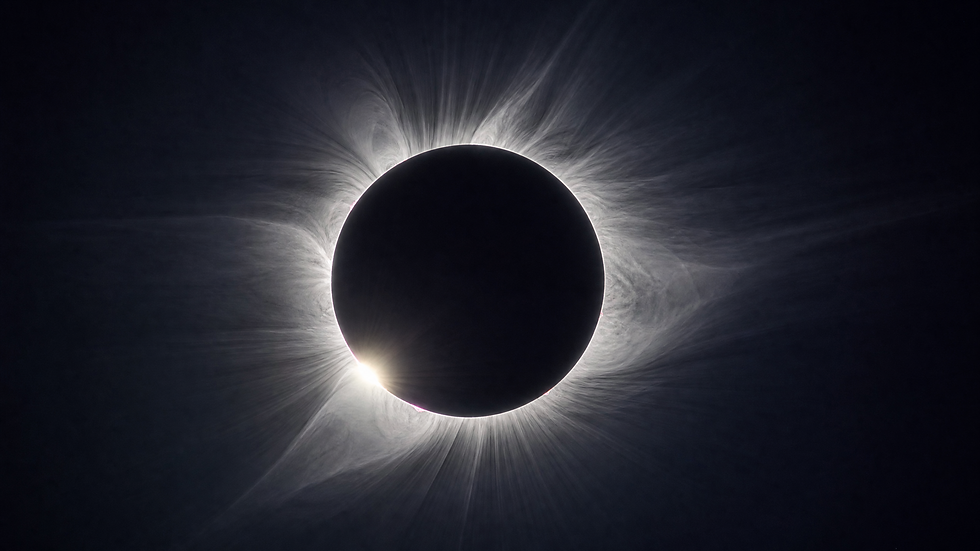
In 1915, Albert Einstein published his General Theory of Relativity, proposing that massive objects like the Sun warp the fabric of space-time, bending the path of light that passes near them. To prove this, scientists needed to observe stars located just behind the Sun to see if their light was deflected. This is impossible under normal conditions because the Sun's glare hides the stars. The only way to test it was during a total solar eclipse .
British astronomer Arthur Eddington organized an expedition to the island of Príncipe off the coast of West Africa to photograph the eclipse of May 29, 1919. Despite poor weather, Eddington managed to capture images showing the stars in the Hyades cluster shifted from their normal positions by exactly the amount Einstein predicted . When the results were announced, Einstein became a global celebrity overnight, and our understanding of the universe was forever changed.
From ancient battlefields to the dawn of modern physics, eclipses have been far more than just beautiful celestial shows—they have been catalysts for human history.


Comments